
This page will be a portfolio of my work during my stay in Granada and a reflection on what I have learned both as a teacher but also as a human being. The page will be divided into course-sections.
At the University of Granada, I'm going to have four different courses but with a red thread connecting them all. All the courses will be in English due to my Spanish at the beginning of the stay was not good enough to be a student, with Spanish as the first language.
My four courses in Spain:
- Development psychology
- Sociology of education
- The teaching of visual arts
- Learning disabilities
Universidad de Granada
- An introduction
The teaching of visual arts
Why study "the teaching visual arts"?
Learning objectives:
-
To develop your own creativity
-
To expand your knowledge of learning methods
-
Learn how to express yourself and be more creative in general
-
To work with different group dynamics
-
Methodology
-
Learning in a relaxed atmosphere (collaboratively)
Games and activities
During the course, we did a lot of different games and activities. Below you will find a description of the games, pictures, videos and my view of how these works and where and how one can use them in a class.
-
Name-game with sound and movement
-
Standing in a circle - One goes into the circle saying his or her name in a special way with a special movement. All the others are repeating this movement and the way the name was said. This game makes people interacted with one another and learning peoples name.
-
-
Warming-up with collaborate movement in class
-
This one can be done in many different ways. The one we did was making a wave-movement from one side of the classroom to the other by during different things with one's hands or feet.
-
-
Circle game - Rhythm feet
-
Everyone stands in a circle. A person starts a rhythm with one or both feet, for example stomping with first the leaf and then the right foot. Then the whole circle has to do it, but in turn, so that the rhythm moves around the circle. After the rhythm is learned the pace can be pushed.
-
-
Drawing an outline of one’s foot
-
An exercise where the student has to draw the outline of their foot and afterwards make colourful drawings inside the outline that describes why they want to be something. In our situation, we had to draw why we would like to become teachers.
-
-
Clap in front, clap behind and stomp
-
This is a collaboration exercise where students have to follow a rhythm which for example can be clap in front, clap behind the body and then stamp in the ground.
-
Other exercises that have been shown in the class by fellow students:
-
Portrait on balloons
-
Ball in cup
-
Flip-flop - making a history
-
Paint and drawing to music (showing one's feelings)
-
Hand-butterflies
-
Making a flower with paper
-
Making numbers and colours with one's body
-
Making a sketch of why you want to be a teacher inside a drawing of your foot
Move after me
We had to prepare a exercise for our fellow students and we chose a exercise called ‘Move after me’. The exercise is about a group around four students who are been given a key-word, for example ‘the ocean’. Then a student from the group makes a movement the resimples the ocean and frieses. The rest of the group will then follow the movement until all has done it and are frozen. Then a new person will make a movement and the procedure will be the same.
The key-words will then change four or five times.
The students are not to speak to each other during the exercise.
Didactic thoughts
This exercise are to change the students creativity, collaboration skills and body language due to the are not allowed to speak to each other.
Another reason this exercises has it purpose is that everybody has to do the same, sometime very funny movements, so no one is left out. This can help the students self-efficacy.

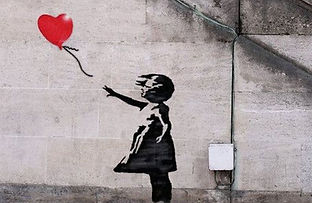

Interesting artist
Art is not just art. Art is a lot of things. Underneath you will find some different artist who expresses themselves in many different ways.
Bansky
Banksy is an anonymous England-based street artist, vandal, political activist, and film director. His satirical street art and subversive epigrams combine dark humour with graffiti executed in a distinctive stencilling technique. His works of political and social commentary have been featured on streets, walls, and bridges of cities throughout the world. Banksy's work grew out of the Bristol underground scene, which involved collaborations between artists and musicians. Banksy says that he was inspired by 3D, a graffiti artist who later became a founding member of the English musical group Massive Attack.
Banksy displays his art on publicly visible surfaces such as walls and self-built physical prop pieces. Banksy no longer sells photographs or reproductions of his street graffiti, but his public 'installations' are regularly resold, often even by removing the wall they were painted on. A small number of Banksy's works are official, non-publicly, sold through Pest Control. Banksy's documentary film Exit Through the Gift Shop (2010) made its debut at the 2010 Sundance Film Festival. In January 2011, he was nominated for the Academy Award for Best Documentary for the film.
In 2014, he was awarded Person of the Year at the 2014 Webby Awards .https://goo.gl/VAo4QZ
Andy Goldsworthy
Andy Goldsworthy (born 26 July 1956) is a British sculptor, photographer and environmentalist who produces site-specific sculptures and land art situated in natural and urban settings. He lives and works in Scotland. https://goo.gl/6Hn3MU
James Turrell
James Turrell (born May 6, 1943) is an American artist primarily concerned with Light and Space. Turrell was a MacArthur Fellow in 1984. Turrell is best known for his work in progress, Roden Crater, a natural cinder cone crater located outside Flagstaff, Arizona that he is turning into a massive naked-eye observatory. https://goo.gl/BgW5Ln


The activity of the day:
The three-headed creature
Three students will sit beside each other in front of the class and take turns to say a word. They have to create a storyline by saying a spontaneous word and hereby collaboratively making up a goofy story. After the (usually) short storyline finishes, a new team can try. The remaining classmates will give the team a subject or ask them a question, in which they will have to answer. It’s a funny little game that can be used as a brain break.
Didactic reflections
To expand the student’s vocabulary and help to improve their sentence structures. Furthermore, it gives the students the push to dare to speak in the classroom. When they are all in the same boat and they can laugh together, their self-efficacy improves. Other than that, their collaboration skills improve and bring smiles on their faces. People are more motivated to learn in a comfortable environment.
Wayang figures
We were drawing with two pens all around a paper to create random figures. When we were finished, we would identify fish look-alike figures. Then we would choose one of these figures and draw it bigger on another piece of paper.
Then the fish would be cut out and we would create figures inside the fish which then would be filed with transparent coloured paper and in the end, the fish would be placed on a stick so it was movable. Then a light source would be making a silhouette of the figure and reflection the different colours onto a wall or a canvas.
Didactic thoughts
This can be used to make a play were children would create a world, for example, an underwater world and present their creations to the rest of the class. It can help the student to express feelings and their imagination in a creative way.
Carioca
What you will need:
-
Sock
-
A small portion of rice (about the amount of the size a closed fist)
-
A meter of string (be aware of what type of string you use, since some can give burn marks when used. A string of fabric would be ideal)
-
Different colours of tissue paper
How to make it:
-
Start by cutting small strings of tissue paper in different colours. They should be around as wide as the size of two fingers width. You will need about 5 pieces of tissue paper strings.
-
Gather the 5 pieces of tissue paper string around the middle and fold the papers, so that the extra thick and durable.
-
Take the sock and pour the rice into it.
-
Then take the meter of string and tie it around the sock securely with the tissue papers thick and folded part in between the sock and string. When tying the string around the sock make sure that you tie it at the one end of the string.
How to use it:
-
When the Carioca is made, the sock with rice works as a weight, so that when you hold the string in the opposite end and swing it around it easily does so. The tissue paper adds colour and movement to it.
-
Students swing the Carioca in different directions: forward, backward, above your head, from one side of your body to the other in the shape of an eternity symbol, etc.
-
Students use it to throw. Swing it around and let it go. You can throw it forward, backward and upward.
-
Student stand on a line to make a wave. One by one the students swing their carioca forward just once, which will create a colourful sight of a wave. Alternative the students can swing it backwards.
-
Students can use it to throw to each other.
-
Students can use two Cariocas and try and swing it in different shapes.
Didactic thoughts
By creating the Cariocas the students get to be creative and hands-on with something. When the Cariocas are made they make it possible for the students to be active and use their motoric skills. The Cariocas make up an endless stream of possible activities. They can be incorporated into different subjects or used as a brain-break where students get to use and work on their motoric skills.
Newspapers/magazines cut out figures
Today, we made figures out of old newspapers and magazines. We glued together random body parts to make a new character.
What you need:
-
Old newspapers and magazines
-
Scissors
-
Glue stick
-
Cardboard paper
-
Wooden skewer (optional)
-
A creative mind and an open-minded approach
How to make it:
Cut out the desired body parts and artefacts to create a new character. Now glue the figure to a cardboard paper to harden the figurine. Attach it to a wooden skewer for more control (optional).
Didactic thoughts:
The students will hereby develop an open mind when approaching new unknown tasks. When giving them a creative challenge with room for their own self-expression. After creating the figurines, they can present them by doing shows for the class. Group-based learning processes will also improve their collaborative and communication skills.
Paper windmills
What you will need:
Makes one big and one small windmill
-
A piece of A4 paper
-
A straw
-
2 push pins
-
An eraser
How to make it:
The big windmill:
-
Fold the paper so that it makes a square. Cut off the extra paper in a nice straight cut. The first photo illustrates how much of the paper need to use and how to fold it.
-
Unfold the paper and fold it again with the other corners, so that it makes an x in the middle of the paper.
-
Unfold the paper again. Now use three of your fingers to measure from the middle out towards each corner and mark the spot.
-
Cut from each corner down to each of the spots.
-
Take the corners marked with A in the photo and collect them in the middle.
-
Take one of the pushpins and push it through the four corners collected in the middle and then through the middle of the paper.
-
Cut a small piece off the straw and push the pushpin through the small piece of straw.
-
-
Finally, push the pushpin the through one end of the straw.
The small windmill:
-
Use the leftover paper from making the big windmill and repeat the step 1 to 6*.
-
Cut another small piece of the straw and push the pushpin through the straw piece.
-
-
Finally, push the push pin into an eraser.
* Since the windmill is smaller this time, only use one finger to measure from the middle of the paper.
Didactic thoughts
The windmills can be used when working with geometry, physics/aerodynamics and history. Geometry since we are working with geometric shapes; rectangle, squares, and triangles. Physics/aerodynamics since we have created something that moves by wind power. Finally, history since windmills has played a great part in agricultural history that nowadays works as green energy. Kids can be active and creative while learning about different subjects.
Do schools kill creativity?
During the lesson, we saw the video “Do schools kill creativity?” (2006), which is a TED talk performed by Sir Ken Robinson (see the video below). We first saw the video and afterwards, in small groups, discussed firstly what the video was about, secondly how we each felt about the topic and finally whether or not it had merits. After the small group discussion, we then had a big class discussion where each group's points of views were presented and then discussed further.
In the video, Sir Ken Robinson talks about how important creativity is. According to him, it is just as important as literacy. Unfortunately, we grow out of creativity since it isn’t nurtured. There is a hierarchy within the subjects, which in most school systems has a subject such as math, literacy, history etc. in the top and artistic subject such as music, arts etc. at the bottom. This is what Sir Ken Robinson wants to make an end to. Kids according to his needs and should be educated in an all-around manner, where all the subject are equal so that the kids will receive the most versatile education possible.
Didactic thoughts
The video and topic are really interesting and for us, as future teachers is an important topic to reflect upon. Creativity is not just about the artistic subject, but also something that needs to be incorporated into every subject. If we can’t be creative in our teaching, how are students supposed to be/stay creative? The didactic thought about this video is not so much what it does for the students, but what it does for us as a teacher. The video teaches/tells us what we have to do/avoid for us to be able to teach and nurture students in the best way possible.
Movement exercises
Today we worked with different movement exercises combined with music.
-
Human train
-
All moved together with the hands on the person in front of one like a train.
-
-
Late for an interview
-
All walked around in an ‘underground station’ with different scenarios in mind. The scenarios were ‘I’m late for the most important interview in my life with three different time aspects, I’m a loser, I find the love of my life, I’m angry at everybody’
-
-
Mixed together
-
A group for about six people stands in a circle, close their eyes and find another person's hands. In the end, the group needs to undo the arm-not without losing the grip.
-
-
Find your inner animal
-
One person goes around and says, for example, five different animals to all students. After all, has been giving an animal, everybody closes their eyes and start making the sound of his or her animal. The will now have to find their fellow animal only by using their hearing.
-
-
Group jukebox
-
Everyone goes inside the circle made by the students, and one of one the start making a sound. In the end, all students will create a jukebox with for example 25 different sounds.
-
-
Human pyramid
-
The human pyramid can be done in various ways. You can do it with a partner or a whole class together. But what you are during is that one takes a position and his or her partner makes a figure by crawling upon the partner.
-
-
Trust
-
In the trust exercises, we did in different versions. Making a V-shape by holding hands face to face and lean backwards, Making a V-shape by standing side by side and lean away from each other.
-
-
The driver
-
One driver, one passenger. The driver leads the passenger around among all the other drivers and passengers with the passenger's eyes closed.
-
Didactic thoughts
This kind of exercises can be used as a form of team building that can help the class to connect and in that way create an environment where for example bullying want to happen. Another form one as a teacher can use one of these exercises can be as a brain break when feeling that is needed.
Second day with movement
Today we worked with movement again. The different activities were:
-
Trust
-
People stood in a circle with one person in the middle. The had to close their eyes and then fall to one side. Then the persons in the circle had to push the person around like a ball bouncing against walls.
-
-
Indian dance
-
An Indian song was put in the radio and a special engine dan was performed by the whole class. The dance had the purpose to release all bad energies from the chest.
-
-
Human figures
-
The students had to find each other and compose different figures with their bodies.
-
-
Rhythm feets
-
Everyone stands in a circle. A person starts a rhythm with one or both feet, for example stomping with first the leaf and then the right foot. Then the whole circle has to do it, but in turn, so that the rhythm moves around the circle. After the rhythm is learned the pace can be pushed.
We did this exercise as a warm-up.
-
-
Robot dance
-
Everybody had to dance like a robot to a certain beat t
-
Didactic thoughts
This kind of exercises can be used as a form of team building that can help the class to connect and in that way create an environment where for example bullying want to happen. Another form one as a teacher can use one of these exercises can be as a brain break when feeling that is needed.
Painting techniques
Materials
-
Normal water-based paint in different colours
-
Paper
-
Ink paper
-
Water-based ink paint
-
Yarn
-
Straw
-
Paint tape
-
Cotton wool
Today we worked with different painting techniques and different types of paint to create a different outcome.
-
Two different colours of normal paint in a cup. Then a piece of yarn which is dipped into the paint and then put inside a folded paper. When pressed between the papers, one is pulling it out by twisting it to make different lines inside the paper.
-
Using a special piece of ink paper and water-based ink paint. One would put some drops of ink painting on the paper and then use a straw to blow the paint around the paper so that it makes different patterns. One can use different colours of paint to create layers inside the patterns.
-
A piece of ink paper will be taped up in different patterns using painting tape, then one will dip a piece of cotton wool into the paint and then make different patterns using different techniques like dabbing and so on. In the end, the tap is ripped off and different clear lines are shown.
Didactic thoughts
This approach to painting shows the children that paint is not only done with a brush and that one can be creative with paint in many different ways which can help them express themselves in many different ways and patterns.
When not using a brush and where students have to paint straight lines, new students who don't have their strength in that particular area can succeed by using different tools.
How can one use a pot in different ways?
A pot is sent around the classroom and the students had to find different ways to use the put. Here are examples from the classroom.
-
Hitting a pot so that the vibrations make different sounds
-
Tennis racket
-
Mirror
-
Hat/helmet
-
Urinal
-
Bell
-
Weapon
-
Directors stick for music (baton)
-
Guitar
-
Spoon
-
Drum
-
Sink
-
Microphone
-
Bowl
-
Scratcher
-
Trophy
-
Palette
Colour to the music
We had to draw to different songs which presented different moods. We had to use different colours that presented the mood we felt when hearing the sound.
-
Caravan Palace called Aftermatch
-
Thrash metal
-
Techno
-
John Legend - All of me
Shadow Happening
Basic information
The term happening was coined by Allan Kaprow in 1956 and refers to a multidisciplinary artistic manifestation carried out by spectators.
Multidisciplinary activity
Changes of roles: Actor / Spectator - Light / Shadow
IMPORTANT: Surprise, expectation, entry together, darkness, music
(Best between 20 and 40 participants)
Objectives of the shadow happening
-
Enjoy being part of a group artistic performance
-
Encourage people to disinhibit themselves and express themselves freely.
-
Discover the artistic and creative potential of this of multidisciplinary activities
There should not be exporters do to it can kill the lust to express oneself
The recipe
-
Keep it a secret
-
Space (Has to be pitch black)
-
Sound system (load and perfect quality
-
Slide projector or powerful light (3 units and different slides with colours
-
Other materials, Large white cloth (hula hoops. balloons, weapons, plastic sheet (waves)
-
Group of volunteers, around six (2 to control the projector, 2 dynamics, one for sound, one or two for photo/video,
The spectators
-
Comfortable black clothes
-
Socks
-
Some kind of costume
Get more inspiration at www.shadowlightghost.com
The activity
All students come into a pitch dark room and then a cloth was lighted with light. Now the students had to dance around the cloth in a circle so that the created different shadows.
The colours of the lighting changed with high volume music throughout the scenery.
Throughout the scenery different probs like weapons, hula was added, so that the students could use these in different ways to create different shadows.
Didactic thoughts
This activity can be used as a way to help the students to express different emotions in different scenarios that are controlled by the mood of the music and light.
It can be a help to a lot of students that it is pitch black and is only their shadows that shown so that the can stay anonymous but still be able to express themselves.


Who Wants To Be A Puppeteer
Shoulders
-
A fluffy, one coloured sock (not black or too dark)
-
2x 25cm bamboo skewers
-
50cm x 50cm bubble wrap
-
Tape
-
Needle and thread
Take to 2 bamboo skewers and put them in the top left corner of the bubble wrap → Then roll it all the way down and tape it → Folds the sides of the roll and tape it → cut the sock in half and put the shoulder base in → sewing it together
Arms
-
50cm x 50cm bubble wrap
-
A fluffy sock
-
Tape
-
Needle and thread
-
Thick string
Cut the bubble wrap into 3 equally large pieces → roll 2 of the pieces and tape it fastens → Put them into pieces of the sock (cut to fit) → sew it to the shoulder base (not too high up) → tie a piece of string to the shoulders, so your hand and wrist can fit through (but tightly)
Clothing
-
A kids shirt with long sleeves
-
A bandana or scarf
-
Fluffy gloves
-
Accessories of preference
Put the body base into the shirt → cut holes underneath the filled part (where the elbows would be) → your hand has to fit through → where gloves for hands
Legs
You can make legs too, but we decided not to.
Head
-
2 fluffy socks (preferably the same colour as the gloves)
-
Matte ping pong balls
-
Yarn or the end of a mop
-
Paint or coloured sharpies
-
Accessories of preference
-
Bubble wrap
-
Needle and thread
-
Cart board
-
Dutch tape
-
Scissors
-
Awl
Step 1: Cut an oval shape in the cart board → cut it in half and tape it together with a 2 cm gab (that will be the base of the head)
Step 2: Put a small piece of bubble wrap into the top the sock → now put the cart board underneath it, so it forms a forehead and a mouth → put another small piece of bubble wrap underneath to form a chin
Step 3: Take the other sock and cut it in half → fill it with bubble wrap and sew the end closed → sew this to the top of the puppet’s head to form a high point of the head, where you can fasten the hair
Step 4: The hair. Either take the end of a mop and sew it on top of the head. Or, make a wig out of yarn. To do so, you take the desired amount and length of yarn and tie them together in small bundles → sew them to the head
Step 5: The eyes. Paint or colour the ping pong balls like eyes → Pinch 2 holes with the awl, on the back of the eyes → push an indent in the middle of the 2 holes to make it easier to sew them the puppet → now sew them to the puppet
Movement and acting
Practice how the move the puppet to make it truly come alive. A funny voice, accent or jokes can really create a good character. You can even make it sing, dance or play an instrument. Just remember the mouth movements are really important for the presentation.
Showtime
We decided to make a game show inspired by “Who wants to be a millionaire”. With our 3 puppets, we had the game master, a dumb blond from the south and the Jamaican "pot-head". The first participant was the dumb blond who thought Europe was a country and lost her chance of winning a million dollars. Afterwards, came the sky-high Jamaican dude, who answered correctly on all the questions. He claimed that Bob Marley whispered the answered in his ear and that he smoked magic weed. Well, a lot can be said, but he went home with the big price.


